
Quieting Your Mind and Getting Sleep
The Midnight Marathon: A Professional’s Guide to Quieting Your Mind and Getting Sleep
Looking for immediate relief? Scroll down to Chapter 5 for a free, guided Non-Sleep Deep Rest audio track you can use right now.
It’s 11:30 PM. Your room is cool and dark. You’ve done your skincare, climbed into bed, and expect to sleep. Instead, your brain flips on—replaying an awkward comment from years ago, making tomorrow’s grocery list, and worrying about your career.
You’re not alone. Many high-achieving people find their minds race at bedtime. Constant connectivity and chronic stress make this common.
Calming your mind at night isn’t mystical. It’s a learnable skill based on psychology, neuroscience, and good sleep habits. This guide explains why your mind wakes up when your body wants sleep, what sleep anxiety is, and practical, science-backed ways to quiet the noise so you can rest.
Chapter 1: Why Your Mind Wakes When You Want to Sleep
To fix it, first understand it. Why does the mind get loud at bedtime?
During the day, your brain handles constant input—emails, messages, calls, social media, and work and home demands. You’re always reacting and producing, so mental activity stays high into the evening.
Because your brain is so busy handling immediate tasks, it pushes background processing—worries, uncompleted tasks, emotional processing—to the back burner.
When you finally lie down in a dark, quiet room, the external stimuli vanish. The distractions are gone. For the first time in sixteen hours, your brain has a moment of uninterrupted silence. And in that vacuum, all the unprocessed thoughts, anxieties, and uncompleted tasks from the day rush to the forefront. Your brain isn't trying to torture you; it is simply taking advantage of the first available downtime to process information.
Chapter 2: The Vicious Cycle of Sleep Anxiety
A racing mind at night often creates sleep anxiety in a predictable loop:
1. Trigger: A stressful day makes falling asleep hard.
2. Fixation: You check the clock. "It’s 1:00 AM—only five hours left."
3. Escalation: The math causes panic. "I have a big presentation; no sleep will ruin it."
4. Chemical response: Panic releases cortisol and adrenaline.
5. Result: You become physically awake and can't sleep.
Over time, your brain links bed with frustration and worry, so the bedroom itself triggers stress. To break the cycle, lower daytime anxiety and use pre-sleep routines that signal safety and relaxation to your nervous system.
Chapter 3: Setting the Stage
Daytime Habits That Impact Nighttime Peace
You cannot live in a state of high-octane stress for 15 hours and expect to power down like a laptop in five minutes. Good sleep begins the moment you wake up.
Caffeine Management
Caffeine is a central nervous system stimulant with a half-life of roughly five to six hours. This means that if you consume a strong 4:00 PM coffee, it still leaves half its caffeine in your blood at 10:00 PM. Even if you feel able to sleep after an evening espresso, caffeine reduces deep, restorative sleep. Stop caffeine at least 10 hours before bedtime.
Managing Your Information Diet
We get more daily information now than people did in a lifetime. Doomscrolling or envy-triggering social media keeps the brain on alert. Be deliberate about what you consume, especially later in the day.

Chapter 4:
The Art of the Wind-Down Routine
If your current pre-bed routine consists of closing your laptop, brushing your teeth, and immediately getting into bed, you are setting yourself up for failure. You need a buffer zone a period of time dedicated to transitioning from the active "doing" phase of the day to the passive "being" phase of the night.
The Golden Hour
Dedicate the final hour before bed to your wind-down routine. This hour should be fiercely protected from work, distressing conversations, and screens.
The Blue Light Problem
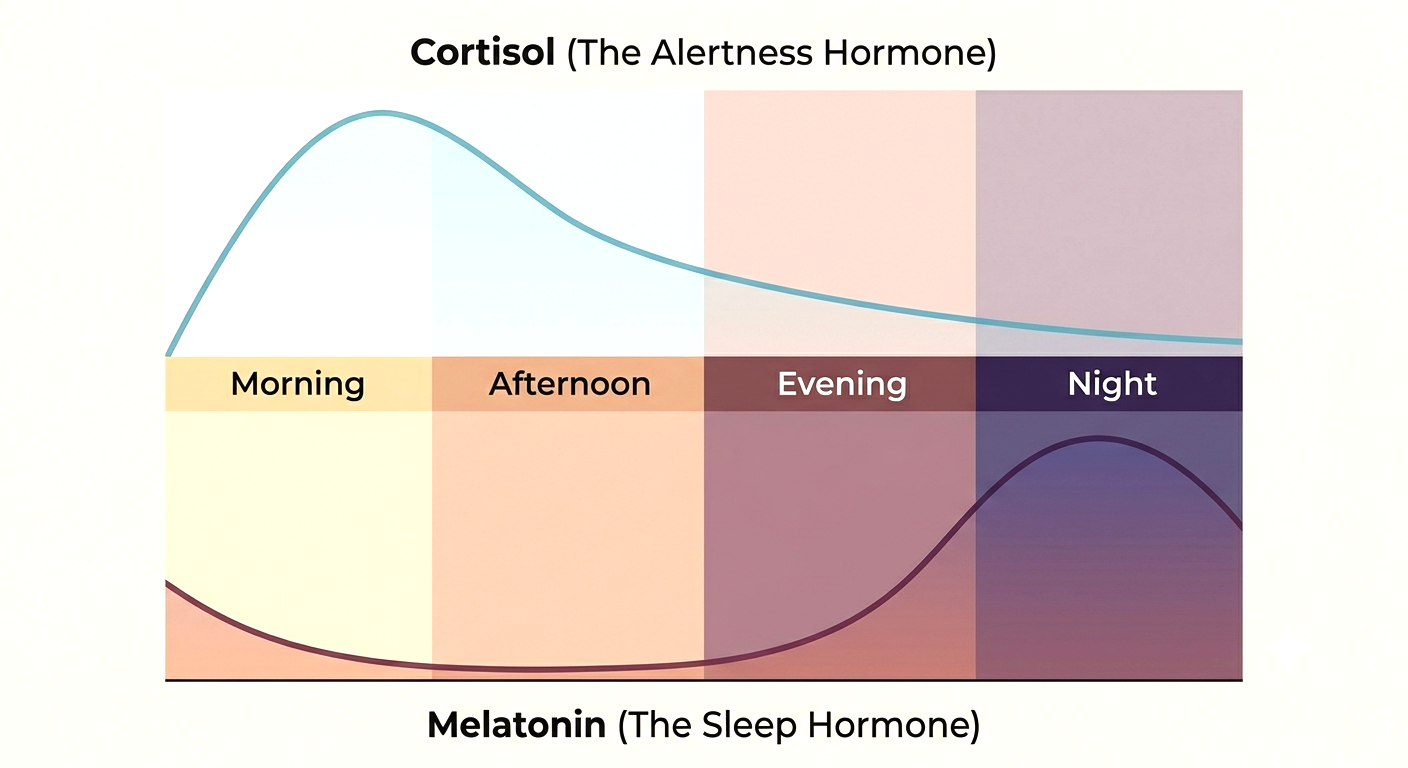
The screens on our phones, tablets, and televisions emit blue light, which mimics the frequency of daylight. When this light hits the photoreceptors in your eyes, it signals to your pineal gland to halt the production of melatonin, the hormone responsible for regulating your sleep-wake cycle. Staring at a screen before bed biologically tricks your brain into thinking the sun is rising. Invest in a physical book, listen to an audiobook or a podcast, or practice gentle stretching instead.
Optimizing the Environment
Your bedroom should be a sanctuary optimized for one primary function: sleep.
Temperature: The human body needs to drop its core temperature by a few degrees to initiate and maintain sleep. Keep your room cool—ideally between 60 to 67 degrees Fahrenheit (15 to 19 degrees Celsius).
Light: Pitch black is the goal. Invest in blackout curtains or a high-quality eye mask. Even the ambient glow of a streetlamp or the LED light of a charging device can disrupt sleep quality.
Sound: If you live in a noisy environment, use a white noise machine or a fan to create a consistent acoustic blanket that masks sudden, jarring sounds.
Chapter 5: Cognitive Strategies to Quiet the Noise
Creating the right environment is crucial, but it won't magically turn off a busy brain. When the intrusive thoughts and anxieties arrive, you need actionable cognitive strategies to manage them.
The "Brain Dump" (Externalizing the Cognitive Load)
One of the primary reasons we worry at night is the fear of forgetting. Your brain loops through your to-do list because it doesn't trust you to remember it tomorrow. Keep a dedicated notebook next to your bed. About an hour before sleep, physically write down everything swirling in your mind. List your tasks for tomorrow, write down the things that annoyed you today, and jot down any lingering questions. You are essentially telling your subconscious, "It is safely recorded here. We do not need to hold onto it tonight."
Conclusion: Patience and Grace in the Process
Silencing a racing mind and relieving pre-sleep anxiety is not an overnight fix. If you have spent years operating at high speeds, it will take time for your nervous system to trust the brakes.
View your sleep hygiene not as a rigid, punishing protocol, but as an act of profound self-care. Be patient with yourself. There will be good nights and challenging nights. When the tough nights happen, grant yourself grace. Remind yourself that a single night of poor sleep will not destroy your life, your career, or your health. By implementing these environmental, cognitive, and somatic strategies, you are slowly but surely rewiring your brain. You are teaching it that the workday is done, the night is safe, and that peace and ultimately, deep, restorative sleep is not only possible, but it is yours to claim.
Turn off the lights, take a deep breath, and let it go. Tomorrow is another day.
Thank you for Reading.
